By Leanna Barrett, Head of Liberty Woodland School
When we talk about how to improve mental health in school, it is easy to think only about what happens when a child is struggling. But good mental health is not simply the absence of a problem. It is having the confidence to express our feelings, the ability to navigate challenges and the security of knowing that support is available when we need it.
That is why I believe mental health and wellbeing should never sit at the edges of school life. They should be woven through a school’s culture, relationships, environment and everyday routines.
At Liberty Woodland School, our aim is not to remove every difficulty from a child’s path. Challenges are an important part of growing up. Instead, I want our pupils to develop the emotional awareness, supportive relationships and practical tools they need to meet those challenges with growing confidence.
The Importance of Mental Health in Education
Children do not leave their feelings at the classroom door. A worry at home can affect their ability to concentrate at school, just as a difficult experience during the school day can travel home with them.
When a child feels anxious, disconnected or overwhelmed, it can become harder to focus, participate, build friendships or take the healthy risks that learning requires. Conversely, when children feel safe, valued and understood, they are more able to be curious, creative and open to challenge.
According to NHS England’s survey on the mental health of children and young people, children aged 8 to 16 with a probable mental health disorder are seven times more likely than children without one to miss more than 15 days of school in a single term. This highlights the importance of protecting mental health at school in practical terms: a child experiencing mental health struggles might not only be having a harder time, but missing out on learning altogether.
The same principle applies to adults. Calm, supported and emotionally available staff are better equipped to notice changes in a child, respond thoughtfully and create positive learning environments.
Education Support’s Teacher Wellbeing Index suggests that in 2025, 76% of education staff and 86% of school leaders reported experiencing workplace stress. Protecting staff wellbeing is therefore not an optional extra or a collection of occasional treats. It is an essential part of caring for the whole school community and individual pupils.
Wellbeing is Created Through Culture
Schools often ask how to improve mental health at school, but there is rarely one programme or intervention that provides the whole answer.
Specialist support is vital when a child needs it, and schools must have clear routes for identifying concerns, working with families and seeking professional help. However, promoting good mental health begins much earlier. It is built through the ordinary experiences children and adults have every day.
Do pupils feel known by the adults around them? Do they have somebody they can approach when something does not feel right? Are emotions treated as useful information rather than inconvenient behaviour? Do children experience movement, fresh air, friendship, purpose and moments of calm? Are staff given the trust and support they need to do their jobs well?
A mentally healthy school is not one in which nobody ever struggles. It is one in which people are able to say that they are struggling and trust that they will be met with care, curiosity and appropriate support.
How We Support Mental Health and Wellbeing at Liberty Woodland School
Our approach at Liberty Woodland School is preventative, relational and deeply connected to the way children learn. The wellbeing practices we follow do not depend on a single lesson or member of staff. Instead, each one is built into the way our school operates, every single day.
We have outlined how we support mental health and wellbeing below, or you can find out more with our primary and secondary school wellbeing pages.
1. Building strong, trusting relationships
Relationships are at the heart of our school. We are on first-name terms with our students. Children need adults with whom they have a strong relationship and who know them well enough to notice when their behaviour, energy or engagement has changed.
We make time for genuine conversation and encourage pupils to speak openly about their feelings. This does not mean every difficult emotion needs to be immediately “fixed”. Sometimes a child first needs an adult to listen, help them make sense of what they are experiencing and remind them that they do not have to manage it alone.
A strong sense of belonging also helps children feel more comfortable asking for support before a concern becomes a crisis.
2. Making emotional literacy part of everyday life
Children need a language for their inner world. When they can recognise and name emotions, they are better able to communicate their needs, understand other people and choose helpful ways to respond.
Emotional literacy is therefore not confined to a single lesson or awareness week. It is reinforced through conversations, reflection, relationships and the way adults respond to children throughout the day.
We want our pupils to understand that every emotion is valid, while also learning that they have choices about what they do with those feelings.
3. Learning in and through nature
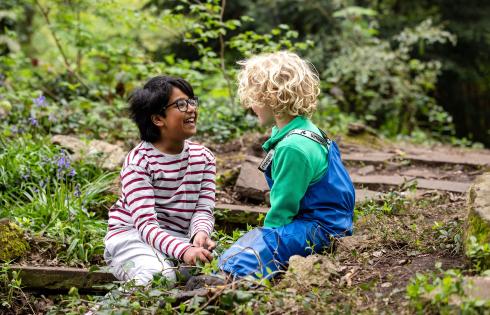
Time outdoors is a fundamental part of life at Liberty Woodland School. Nature offers space to move, explore, breathe and reset. It can provide both stimulation and calm, giving children a welcome counterbalance to the increasingly screen-based nature of modern childhood.
Outdoor learning also creates meaningful opportunities for teamwork, problem-solving, managed risk and perseverance. Children learn that discomfort can be temporary, that mistakes can be useful and that confidence grows through doing difficult things with the right support.
These experiences help pupils build a practical, lived form of resilience rather than simply being told to “be resilient”.
Find out more about the importance of outdoor learning
4. Creating space for movement, creativity and purpose
Wellbeing is supported when children experience a broad and meaningful education. Physical activity, creative expression, practical work and time spent contributing to a shared goal all provide different ways for pupils to experience competence and connection.
Not every child finds their confidence in the same place. A varied school day allows children to discover their strengths, express themselves and experience success beyond a narrow definition of achievement.
This is particularly important for pupils who may find more conventional classroom environments overwhelming or limiting.
5. Listening to pupil voice
Children’s wellbeing improves when they feel that their views matter. Giving pupils meaningful opportunities to contribute to decisions helps them develop agency, responsibility and a stronger sense of belonging.
Listening to children does not mean adults step away from leadership or that pupils always get the answer they want. It means taking their experiences seriously, explaining decisions and making space for them to influence the community of which they are a part.
6. Working in partnership with families
A child’s school life and home life are closely connected, so communication with parents and carers is essential. Families know their children in ways that schools cannot, while educators may notice patterns or changes that are less visible at home.
When school and family approach concerns with openness and without blame, they can build a fuller picture of what a child may need. Early, honest conversation can often prevent a difficulty from becoming more deeply rooted.
7. Supporting the adults who support children
Any conversation about how to improve wellbeing in schools must include staff.
Working with children is joyful and purposeful, but it can also be emotionally demanding. Staff need clear expectations, supportive leadership, opportunities to talk and a culture in which asking for help is viewed as responsible rather than weak.
Adults also model attitudes towards wellbeing every day. When children see trusted adults communicate honestly, establish healthy boundaries, seek support and recover from mistakes, they learn that looking after our mental health is a normal part of life.
Wellbeing in School Does Not Mean Avoiding Challenge
I am cautious of approaches to wellbeing that suggest children should always feel happy or comfortable. That is neither realistic nor helpful.
Young people need opportunities to experience disappointment, uncertainty, disagreement and failure within safe, supportive relationships. If we remove every obstacle, we also remove opportunities to develop perseverance, self-knowledge and confidence.
Prioritising wellbeing is sometimes assumed to come at the cost of academic rigour, as though a school has to choose between the two. We would argue the opposite of this is true.
A child who feels secure enough to ask for help is better placed to take on genuine academic challenge, rather than less able to. Our blog on whether homework should exist explores this balance between wellbeing and academics in more detail.
Our role is not to make life permanently easy. It is to help children understand that difficult feelings can be managed, challenges can be worked through, and support is available. Resilience grows when a child can look back at something hard and think, “I found a way through that. I can do difficult things.”
Mental Health is a Whole-School Commitment
There is no single answer to how to improve mental health at school. Meaningful change comes from looking at the whole experience of school: its relationships, curriculum, physical environment, leadership, communication and expectations.
It means noticing children before they reach a crisis point, taking staff wellbeing seriously, and creating a culture in which people feel safe enough to be honest.
Most importantly, it means understanding that wellbeing is not a distraction from education. It is one of the foundations that makes meaningful learning possible.
At Liberty Woodland School, I want every child to leave us with more than knowledge. I want them to know themselves, trust that their voice matters, form healthy relationships and feel able to meet the wider world with courage and hope.
That, to me, is what a truly successful education should make possible.
Visit Liberty Woodland School
If you would like to see what our commitment to mental health in education looks like in practice, our open days are the best way to experience what makes our school so special.
We encourage you to visit us, take a look around our primary and secondary school grounds, and ask us any questions you have about pastoral care, our curriculum, and day-to-day life at Liberty Woodland School.