
There is a quiet sadness many parents feel about modern childhood, even if they struggle to name it. Children are spending more time indoors than any generation before them. More time on screens. More time managed, monitored and hurried from one activity to the next. Many can navigate YouTube before they can climb a tree or recognise the birds outside their window.
Beneath all of this, many parents are beginning to ask deeper questions about education.
Not simply: Will my child succeed academically?
But: What kind of person is my child becoming as they grow up?
This is part of why environmental education matters far more deeply than people sometimes realise. At its simplest, it is the practice of teaching children to understand, care for, and take responsibility for the natural world. Not as an abstract subject, but as a lived, daily part of how they learn.
What Environmental Education Actually Means
True environmental education is not simply about teaching children facts about climate change or recycling. It is about preserving some of the conditions healthy childhood depends upon: wonder, curiosity, groundedness, responsibility and connection to the real world.
In England, environmental education has never been a required, standalone part of the National Curriculum. That leaves how, when, and whether it is taught largely up to individual schools.
The Department for Education’s Sustainability and Climate Change Strategy commits to preparing young people for a world shaped by climate change, but how that translates into a child’s actual school week still varies from one school to the next.
At Liberty Woodland School, we believe children learn best when childhood remains joyful, relationships remain strong, and learning feels meaningful and connected to life beyond the classroom. Here, environmental education is not occasional or elective. It is built into the rhythm of our students’ school day, rather than bolted on to it.
Environmental Education Is Really About Relationship
The phrase environmental education can sometimes sound technical or abstract. But at its heart, it is really about relationship.
A child who has grown vegetables understands food differently. A child who has cared for animals understands responsibility differently. A child who has watched seasons change closely begins to understand interdependence not as a theory, but as lived experience.
Nature offers children something increasingly rare in modern life: patience, slowness and perspective.
A woodland does not adapt itself to short attention spans. A seed cannot be rushed. The natural world quietly teaches children that they are part of systems larger than themselves, and increasingly, that matters.
Children Need More Than Indoor Lives
Many children today live surprisingly detached lives from the natural world. Yet children still need the same things they always have:
- Movement and adventure: The freedom to run, climb, and test their own limits.
- Belonging and imagination: The space to build, invent, and take on roles of their own choosing.
- Freedom and opportunities to contribute meaningfully: Real responsibility, rather than supervised activity.
Environmental education helps restore some of these missing experiences.
A child balancing across a fallen tree is learning judgement and confidence. A child building a den is collaborating, solving problems and taking risks. A child observing insects beneath a log is developing something increasingly endangered in modern life: attention.
Children are not designed to learn only through abstraction. They learn through movement, relationships and direct experience of the world around them.
What Environmental Education Looks Like at Liberty Woodland School
For us, environmental education is not a philosophy that stays at the level of theory. We embed it in several concrete ways across the school and our curriculum:
Connection with the Outdoors
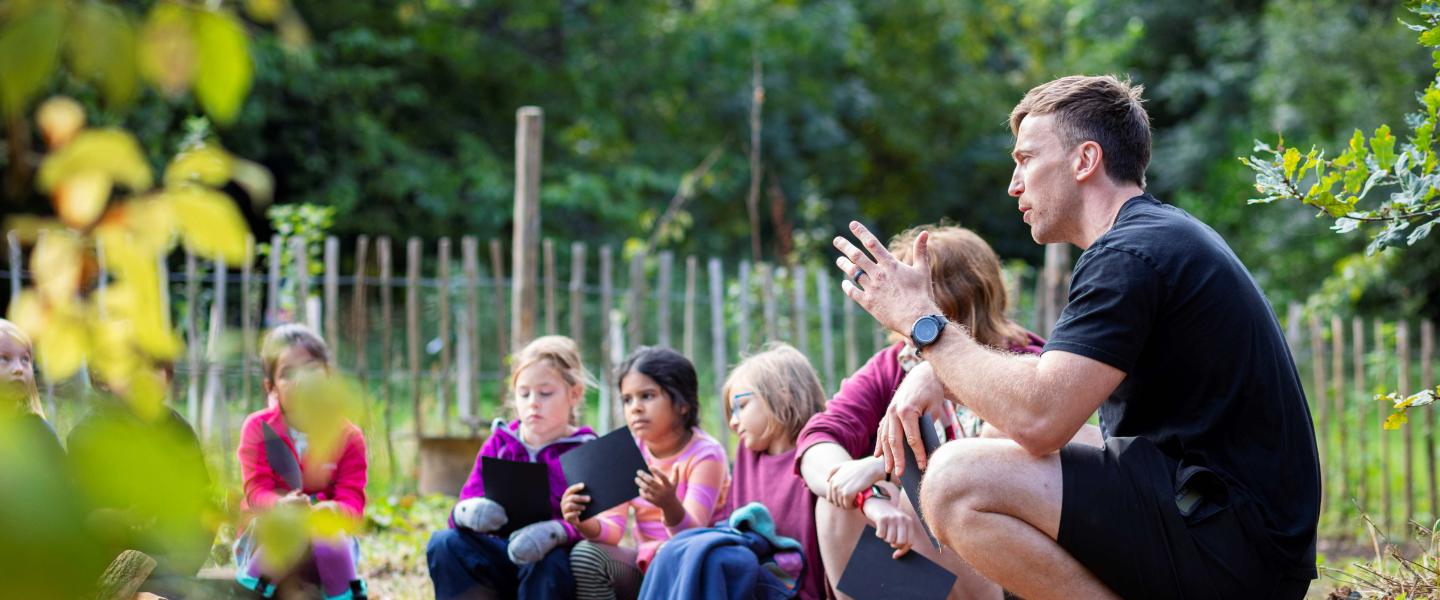
Outdoor learning runs through every school day for our primary school students. It is through this daily, unhurried time outside that our youngest children build real environmental awareness. They notice which plants are flowering, which insects have appeared, and how the ground changes after rain, long before they are asked to write an essay about any of it.
Building a strong awareness and connection with the outdoors teaches them how to appreciate the world around them, preserving childhood and encouraging personal and academic growth.
Environmentalism as a Timetabled Lesson
We also reinforce understanding of the environment and the world around us through formal teaching. Environmentalism is a timetabled lesson in both our primary school and secondary school, rather than a theme that is picked up occasionally within another subject.
Environmental Sciences in Secondary School
As students move into secondary school, learning shifts more towards environmental sciences. Children build on the connection and curiosity they developed during their primary education, but with a deeper, clearer scientific understanding of the mechanisms behind environmental issues and the impact they can have on the world, individually and collectively.
Real Learning Feels Different
At Liberty Woodland School, one of our core beliefs is that learning should feel meaningful, purposeful and connected to real life. Environmental education naturally supports this because it invites children into real questions and real problems.
Why are pollinators disappearing?
How should humans use land responsibly?
What makes communities sustainable?
When learning feels real, children often engage more deeply because meaning creates motivation. This is one reason we reject the false idea that joyful childhood and serious learning are opposites.
They are not.
Children who feel emotionally secure, deeply engaged and meaningfully connected to their learning are often far more capable of intellectual challenge.
Environmental Education Is Future Education
The children growing up today will inherit a world shaped by enormous environmental, technological and ethical questions.
They will need more than information alone. They will need resilience, discernment, adaptability, practical competence and the ability to think deeply about the world around them.
But perhaps most importantly, they will need to remain connected: to nature, to community and to themselves. Because one of the greatest challenges facing modern childhood is not simply environmental crisis. It is disconnection.
And education should help children feel more fully alive in the world, not further removed from it.
If you would like to see what our progressive approach to education looks like in practice, sign up to attend one of our open days - we would love to welcome you.


