A Different Approach to Learning Beyond the School Day
Homework has long been seen as part of the fabric of school. A given. A non-negotiable.
But more and more, parents are asking a simple question:
Is homework actually beneficial?
And perhaps a better one:
What might children gain if we rethought it entirely?
The Argument For Homework
For many families, homework is seen as a natural extension of learning. As a normal element of schooling. Something to be expected.
Supporters of homework argue that homework helps:
- Reinforce classroom teaching
- Build discipline
- Hold children accountable for their work
- Teach independence
- Give parents a better understanding of what their child is learning at school
- Improve academic performance
But do all of these benefits have to come from assigning traditional homework? And do the negatives outweigh the positives?
Why Homework Might Be Less Beneficial Than You Think
The necessity of homework has long been debated, with research asking the question: Is homework beneficial because it genuinely improves learning, or because it keeps children busy?
When thinking about homework, people often forget to consider the impact it can have on children outside of academic performance.
More attention should be paid to the impact it has on personal development and wellbeing. Because when we build strong individuals, we build strong learners.
More Doesn’t Mean Better
After a full day of school, most children are tired - mentally, emotionally, and often physically.
Adding more structured work into the evening doesn’t always deepen learning. Often, it does the opposite.
Homework can become:
- A source of stress
- A point of tension at home
- A task to complete, rather than learning to engage with
And in that shift, something important is lost. The sense that learning is purposeful, not just persistent.
Because children are perceptive. They know when something matters, and when it doesn’t.
And if it doesn’t feel purposeful or relevant… what’s the point in doing it?
Life Outside the Classroom Matters
The hours after school are not empty space to be filled.
They are where childhood unfolds.
This is where children:
- Talk about their day (or choose not to)
- Play, imagine, and decompress
- Spend time with family
- Follow their own interests
These moments matter. They shape wellbeing, relationships, and identity.
And they create the conditions in which learning can actually take root.
The Benefits of No Homework in Primary Years
In the early years, removing homework isn’t about doing less, it’s about doing what matters most.
Research over decades, including work by John Hattie, suggests that in the primary years, homework has little to no measurable impact on academic outcomes.
So instead of worksheets or set tasks, the focus shifts to something far more powerful:
Reading, and real life.
Being read to. Reading together. Reading independently.
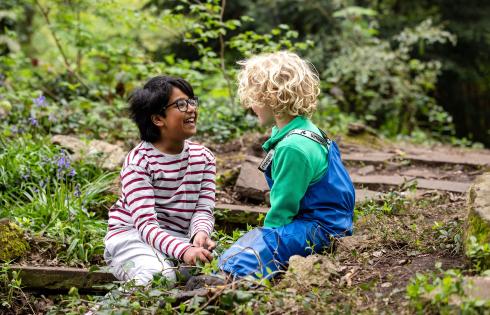
And just as importantly, having time for:
- Passions and interests
- Clubs, hobbies, and creative pursuits that follow your individual strengths
- Unstructured play
- Simply switching off and enjoying family time
This is where families reconnect.
Where conversations replace corrections.
Where children are seen not as students completing tasks, but as individuals growing, exploring, and becoming.
It’s not the absence of learning, it’s a broader, richer version of it.
A Different Model for Secondary Students
As children grow, so does their capacity for independence. But independence isn’t something that appears overnight. It needs to be developed, deliberately.
Rather than traditional homework, a different approach can be taken.
One that moves away from daily tasks and towards independent learning.
Secondary school students at Liberty Woodland School begin their Friday mornings with an online pastoral check-in from home, before moving into a focused, time-bound block of independent study.
They are expected to:
- Plan and manage their workload
- Focus on a small number of subjects
- Work with sustained attention
- Take ownership of their progress
This isn’t homework filled with worksheets.
It’s learning that develops both subject knowledge and, more importantly, the ability to work independently.
Why Time-Limited Learning Matters
There is an important boundary built into this independent learning model:
the work stops.
After a set period, around two to three hours each week, students finish, whether everything is complete or not.
Because wellbeing matters.
This offers students time for:
- Sport
- Creativity
- Personal interests
- Rest and social connection
This time is not something to be earned. It is essential.
And if a student doesn’t complete everything? That matters too.
It gives us valuable insight into:
- Where they need support
- What scaffolding might help
- How they manage their time and thinking
The struggle becomes information. And that’s where real teaching begins.
Learning How to Learn
In this model, independent learning is not about completing tasks for the sake of it.
Because again, if learning is just about getting through a checklist… what’s the point in doing it?
Instead, it’s about developing the habits that underpin lifelong learning:
- Initiative
- Time management
- Focus and perseverance
- Self-awareness
Students begin to understand not just what they are learning, but how they learn.
So, Is Homework Beneficial?
It can be, but only when it is purposeful, intentional, and meaningful.
For younger children, the benefits of no homework are clear: more time to read, to play, to connect, and to grow.
For older students, the goal shifts, not to increase volume, but to build independence in a structured, thoughtful way.
Because education isn’t about filling every available hour with work.
It’s about creating the conditions in which children can thrive.
And sometimes, that means having the confidence to step away from what has always been done…
and choosing something better.
Discover Our Progressive Approach to Learning
At Liberty Woodland School, we believe children learn best when they feel safe, known, and genuinely engaged in learning.
Our progressive approach to education aims to balance academic progress with personal development, independence, self-confidence, and wellbeing.
Learn more about what makes our primary school curriculum and secondary school curriculum so unique, or book to attend an open day to experience what makes our school special, first-hand.